 Skip to content

Which Species to Choose for Your Custom Projects?
Wood Veneer: Which Species to Choose for Your Custom Projects?
Understanding Veneer Sheet Before Choosing a Species
Choosing a wood species for veneer is a critical step in any architectural, furniture, or interior design project. Whether used for decorative panels, custom millwork, or furniture applications, wood veneer plays a direct role in the final appearance, visual consistency, and perceived quality of a surface.
Certain domestic wood species are widely appreciated for their consistency, versatility, and ability to adapt to a broad range of design contexts, from contemporary spaces to more traditional environments. However, the appearance of a veneer sheet is not determined by the species alone.
The type of cut defines the grain pattern, while the tree’s age, growth conditions, and internal structure influence the grain’s texture, regularity, and color variation. This combination of factors explains the wide range of visual outcomes possible in wood veneer, even when working with the same species.
Before selecting a species, it is therefore essential to understand the key elements that influence its appearance, in order to make a choice that is both visually coherent and well suited to the project requirements.

White Oak: A Wood Veneer Species with Multiple Visual Expressions
Color Range
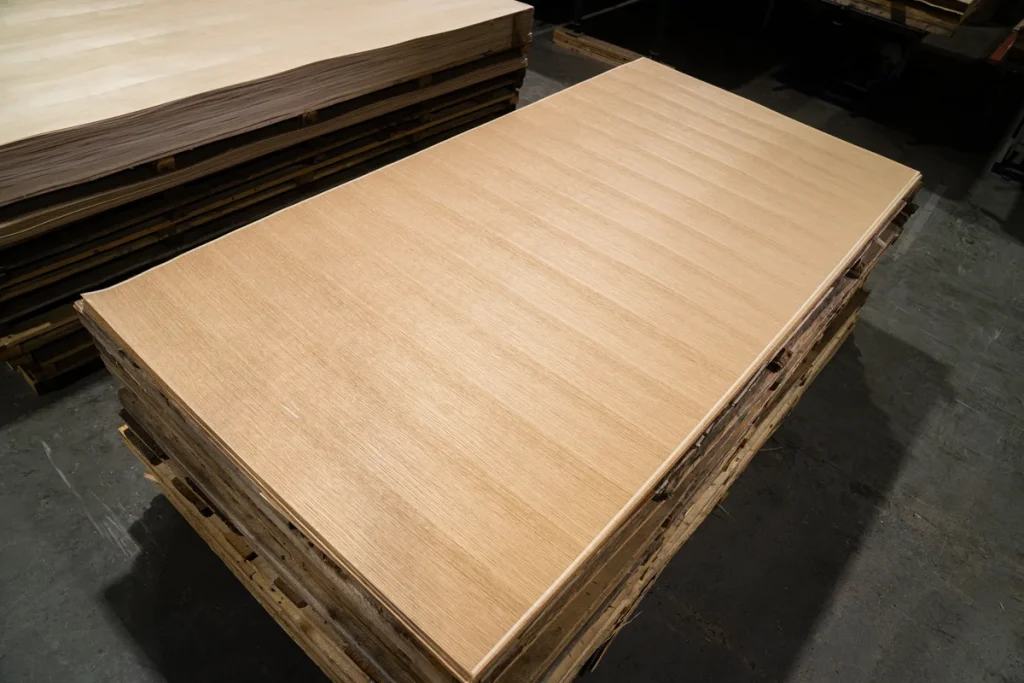
In veneer sheet form, white oak displays a color range from very light beige to a pale brown with subtle golden undertones. This natural palette is delicate, sometimes leaning toward soft pinkish, grayish, or light taupe hues, depending on the tree and the cut.
The overall appearance remains harmonious and bright, with a gentle warmth and understated elegance that define the species.
How Cut Type Affects Appearance
When flat cut, white oak veneer almost always shows cathedral grain patterns, which may appear more open or more compact depending on the tree’s structure. These cathedral figures can be broad and pronounced or tighter, more regular, or even interrupted. The resulting appearance clearly highlights the wood grain and gives the surface a natural, lively character.
When quarter cut, the grain becomes noticeably straighter and more structured, giving the veneer a more uniform overall look. In some cases, medullary rays appear, creating flake patterns whose intensity can vary significantly from one tree to another. This cut offers a good balance between the wood’s natural character and visual control.
Rift-cut veneer, used primarily for white oak and red oak, pushes the pursuit of regularity even further. The grain is often, but not necessarily, straight, uniform and continuous, with a marked reduction in secondary features such as flake. The result is a veneer sheet with a highly consistent appearance, particularly well suited to large surfaces and contemporary projects where visual uniformity is essential.
Walnut: Depth of Tone and Richness in Wood Veneer
Color Range

In veneer sheet form, walnut is distinguished by a rich color range that can vary from light brown to deep brown, often marked by darker veining. This natural palette is nuanced, sometimes leaning toward grayish, purplish, or slightly reddish tones, depending on the tree and the cut.
Subtle variations in tone and contrast may appear from one sheet to another, enhancing the natural character of the material. This diversity is an integral part of walnut’s identity and contributes greatly to its appeal in veneer.
How Cut Type Affects Appearance
When flat cut, walnut veneer develops well-defined cathedral grain patterns that are often emphasized by natural color contrast. Depending on the tree, these patterns may appear broad and highly expressive or tighter and more understated. The resulting appearance creates a strong sense of depth and naturally draws the eye, making it well suited for designs where the wood plays a central role.
When quarter cut, this species takes on a more uniform appearance. The grain becomes straighter and more continuous, which tends to soften visual contrasts. However, the presence of flares or narrow sheets can still introduce some contrast, without diminishing the richness of the color. This cut allows for more regular surfaces, well suited to contemporary or corporate environments.

Maple: Light Tones and Visual Control in Veneer Sheets
Color Range
Maple offers a light color range, extending from nearly pure white to an off-white, pale cream tone, sometimes accompanied by subtle golden or slightly pinkish undertones. These variations are generally subtle and may depend on the individual tree, its growth, and the specific area of the log.
Over time and with exposure to light, maple tends to warm slightly, evolving toward softer tones without losing its clarity.

How Cut Type Affects Appearance
When flat cut, maple also displays cathedral grain patterns, although they are typically less contrasted than those found in oak or walnut. Depending on the tree, these cathedrals may appear tight and discreet or slightly more open. The resulting appearance remains relatively balanced and introduces a light visual texture, without dominating the overall surface.
When quarter cut, maple reveals a straighter and more regular grain. Its appearance is clear and relatively uniform, although it may still display subtle flares or natural characteristics, which makes it particularly well suited for large panels. This cut allows for a surface that is often used as an architectural backdrop, where the wood supports the design rather than drawing attention to itself.
An appropriate matching technique, such as plank match, helps harmonize the appearance of a veneer sheet by distributing its natural characteristics more evenly.
One Species, a Wide Range of Veneer Appearances
Even when working with the same species and cut, wood veneer sheets can present noticeable differences in grain width, pattern intensity, and color variation. These differences are directly related to the individual tree and represent one of the material’s inherent strengths. In wood veneer production, this variability requires careful selection and sorting to ensure visual consistency across panels, particularly in architectural and manufacturing applications.
Conclusion
Several domestic wood species are widely appreciated in wood veneer for the richness and diversity of their visual expressions. Each offers distinct characteristics in terms of color, grain, and overall behavior, allowing for a wide range of design intentions and technical requirements.
While some species are more commonly specified, there is a broad range of lesser-known options that can be equally relevant depending on the context of the project. The right choice is therefore not based solely on popularity, but on how well the material integrates with the overall design intent.
Understanding that the cut defines the pattern, while the species and the tree determine its expression, remains essential for creating veneer surfaces that are consistent, durable, and aligned with contemporary architectural and design standards. To explore further, you can consult our wood veneer species to discover the options available for your projects.
Share this article